 2021, Vol. 19

 [PDF全文]

在智能通信系统中,编码识别是解码的前提,编码参数的盲识别问题一直是盲信号处理领域研究的重点课题之一。RS码是一类纠错能力很强的前向纠错编码,广泛应用于各种无线通信系统中,因而成为编码识别领域的重要研究对象之一。目前RS码的主要识别方法有欧几里得分析法[1]、矩阵分析法[2-5]、码根统计分析法[6-8]、有限域傅里叶变换(Galois Field Fourier Transform,GFFT)分析法[9-12]等。GFFT分析法亦称为谱累积量(Spectrum Cumulant)分析法,由于完善的理论体系及较为理想的识别性能,已成为RS码的主流分析方法;但是,该方法需要遍历所有可能的有限域及有限域中的所有元素,导致计算量较大,识别速度慢。为此,文献[13]利用编码域本原元是RS码码根这一特性提出一种快速识别方法,把编码域的识别与生成多项式的识别分离,在一定程度上提高了识别速度,但该方法依然涉及大量高阶有限域运算,速度提高有限。为了进一步提高识别速度,本文提出一种基于校验和的识别方法,把谱累积量运算转换为校验矩阵的校验和运算,主要运算在
定义在
| $ g(x) = (x - {\alpha ^{{t_0}}})(x - {\alpha ^{{t_0} + 1}}) \cdots (x - {\alpha ^{{t_0} + 2t - 1}}) $ | (1) |
式中:m为该RS码的阶数;
假设
定义:记
命题1:定义在
证明:由码根的定义及RS码的生成多项式表示形式可知,
命题2:对于定义在
证明:由于
根据命题1和命题2可知,可以把RS码的识别分为2步:a)编码域的识别,即阶数m及本原多项式
根据命题2,对于定义在
| $ {\mathit{\boldsymbol{C}}} \cdot {{\mathit{\boldsymbol{H}}}^T} = 0 $ | (2) |
对于任一m阶(n, k)RS码,都存在一个等价的(mn, mk)二进制线性分组码,设与RS码字C对应的二进制线性分组码的码字为Cb;同理,以
| $ {{\mathit{\boldsymbol{C}}}_b} \cdot {\mathit{\boldsymbol{H}}}_b^T = 0 $ | (3) |
式中Hb为
由定义可知,
识别出编码域
| $ CH(l) = \frac{1}{{Mm}}\sum\limits_{i = 1}^M {\sum\limits_{j = 1}^m {{{\mathit{\boldsymbol{R}}}_{b, i}}{\mathit{\boldsymbol{h}}}_{b, l, j}^T} } ,0 \leqslant l \leqslant (n - 1) $ | (4) |
式中hb, l, j为Hb, l中的第j个行向量。如果
直接法直接利用BCH码的连续码根特性识别t0和t,需要进行多个二元假设检验,随着t的增大必然会降低正确识别率,为此需要对识别算法进行改进。
首先,计算除l=0外的所有校验和
| $ {b_l} = \left\{ \begin{gathered} - 1, \quad CH(l) < T \\ 1, \quad \;\;CH(l) \geqslant T \\ \end{gathered} \right. , \;0 \leqslant l \leqslant (n - 1) $ | (5) |
然后,构造如下序列
| $ w(d) = 1 - 2pulse(1, d, n - 1), \;1 \leqslant d \leqslant (n - 2) $ | (6) |
式中
| $ prod(d) = \prod\limits_{l = 1}^{n - 1} {w(d, l) \cdot {b_l}} $ | (7) |
显然,当
| $ \hat d = \mathop {\arg \max }\limits_d prod(d) $ | (8) |
| $ \left\{ \begin{array}{l} {{\hat t}_0} = 1, \hat t = \frac{{\hat d}}{2}\begin{array}{*{20}{c}} {} \end{array}\begin{array}{*{20}{c}} {} \end{array}\begin{array}{*{20}{c}} {} \end{array}\begin{array}{*{20}{c}} {} \end{array}\begin{array}{*{20}{c}} {} \end{array}\begin{array}{*{20}{c}} {} \end{array}rem(\hat d, 2) = 0 \\ {{\hat t}_0} = 0, \hat t = \frac{{(\hat d + 1)}}{2}\begin{array}{*{20}{c}} {} \end{array}\begin{array}{*{20}{c}} {} \end{array}rem(\hat d, 2) = 1 \\ \end{array} \right. $ | (9) |
式(8)实际上是2个序列的相关,所以称此方法为相关法。得到
由2.1.1和2.1.2可知,上述算法的关键是求取Hb, l,而分析等价二进制线性分组码与m进制原循环码之间的关系是比较复杂的。为此,本文采用高斯约旦消元法直接利用二进制线性分组码数据求取对应的校验矩阵[14]。
对于阶数m、本原多项式
| $ {v_i}(x) = {u_i}(x)(x - {\alpha ^l}) $ | (10) |
式中
| $ {\mathit{\boldsymbol{B}}} = {\mathit{\boldsymbol{A\Phi}}} $ | (11) |
式中:B是
| $ {{\mathit{\boldsymbol{H}}}_{b, l}} = {[\begin{array}{*{20}{c}} {{{\mathit{\boldsymbol{\phi}}} _{{\lambda _1}}}}&{{{\mathit{\boldsymbol{\phi}}} _{{\lambda _2}}}}& \cdots &{{{\mathit{\boldsymbol{\phi}}} _{{\lambda _m}}}} \end{array}]^T} $ | (12) |
上述求取方法随着阶数的增大,计算量会显著增加,所以在识别前需要离线求出待识别阶数范围内所有的校验矩阵,并保存起来,识别时直接读取,即以存储空间换取识别速度;不过,由于存储的都是二进制数据,所需要的存储空间不大;以8阶RS码为例,所需的存储空间为2 040×2 040×16≈6.5 MB。
2.2 阈值的选取由文献[15]可知,假设
由此可以得到,当M足够大时校验和
1) 当
| $ CH(l) \sim N({E_1}, {D_1}) $ | (13) |
式中:
2) 其他情况下,
| $ CH(l) \sim N({E_0}, {D_0}) $ | (14) |
式中:
因为
| $ H = \left\{ \begin{gathered} {H_1}\begin{array}{*{20}{c}} {}&{CH(l) < T} \end{array} \\ {H_0}\begin{array}{*{20}{c}} {}&{CH(l) \geqslant T} \end{array} \\ \end{gathered} \right.\quad\quad{E_1} < T < {E_0} $ | (15) |
式中:H0表示
得到
| $ T = \frac{{{E_1}\sqrt {{D_0}} + {E_0}\sqrt {{D_1}} }}{{\sqrt {{D_0}} + \sqrt {{D_1}} }} $ | (16) |
分析可知,按式(17)确定的阈值与
令
| $ \alpha = \frac{{{E_0} - T}}{{\sqrt {{D_0}} }} = \frac{{T - {E_1}}}{{\sqrt {{D_1}} }} = \frac{{{E_0} - {E_1}}}{{\sqrt {{D_0}} + \sqrt {{D_1}} }} $ | (17) |
为了保证足够高的正确识别率和足够低的虚警概率,根据3σ准则,
| $ M \geqslant 9{\left( {\frac{{\sqrt {{d_1}} + \sqrt {{d_0}} }}{{{E_0} - {E_1}}}} \right)^2} $ | (18) |
式中:
| ${M_{\min }} = \left\lceil {9{{\left( {\frac{{\sqrt {{d_1}} + \sqrt {{d_0}} }}{{{E_0} - {E_1}}}} \right)}^2}} \right\rceil $ | (19) |
谱累计量具有类似的性质,可以得到类似的结论,
| $ {M'_{\min }} = \left\lceil {9{{\left( {\frac{{\sqrt {{{d'}_1}} + \sqrt {{{d'}_0}} }}{{{{e'}_0} - {{e'}_1}}}} \right)}^2}} \right\rceil $ | (20) |
式中:
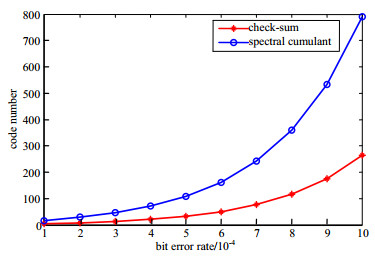 |
| Fig.1 Code number for different bit error rates 图 1 码字数随误比特率变化曲线 |
实际应用中8阶RS码应用最广,所以这里以8阶RS码为例进行仿真。待识别RS码的本原多项式在所有8阶本原多项式集合中随机选取;识别时,阶数搜索范围为3~8,采用BPSK调制方式,噪声为高斯白噪声,每次试验重复测试1 000次,统计正确识别率。
3.1 编码域的识别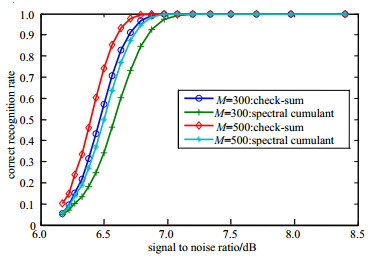 |
| Fig.2 CRR of the code field for different SNRs 图 2 编码域识别性能随信噪比变化曲线 |
图 3给出了误比特率0.001,码字数取50~1 000(步进50)时,正确识别率随码字数的变化,由图可知,当
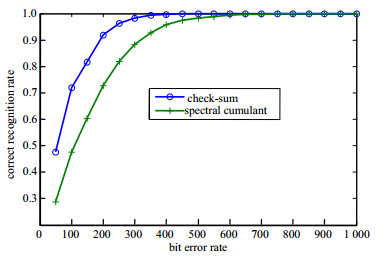 |
| Fig.3 CRR of the code field for different code numbers when τ=0.001 图 3 τ=0.001时编码域识别性能随码字数变化曲线 |
由2.1.2可知,生成多项式
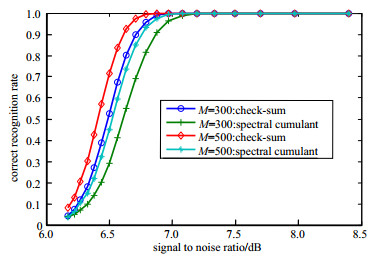 |
| Fig.4 CRR of the generator polynomial when t=1 图 4 t=1时生成多项式识别性能随信噪比变化曲线 |
为了对比直接法和相关法识别t0和
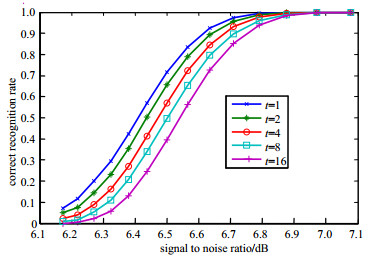 |
| Fig.5 CRR of the generator polynomial using direct method 图 5 t取不同值时直接法生成多项式识别性能 |
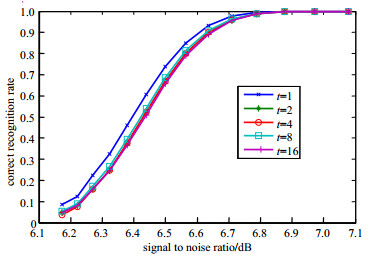 |
| Fig.6 CRR of the generator polynomial using correlation method 图 6 t取不同值时相关法生成多项式识别性能 |
本文从RS码的码根特性出发,提出一种基于校验和的识别方法。仿真试验结果表明,无论是在识别速度方面还是在数据量需求方面,本文所提方法都远优于谱累积量方法。而且,由于校验和计算仅涉及二进制运算和十进制运算,容易用硬件描述语言实现,所以更有利于应用于实时系统中。
此外,由于需要利用二进制校验矩阵,所以本文方法可以很方便地转换为基于软信息的识别方法。软信息中包含了每个比特的可靠性信息,因此利用软信息进行识别有望进一步提高识别性能,值得深入研究。
| [1] |
戚林, 郝士琦, 李今山. 基于有限域欧几里德算法的RS码识别[J]. 探测与控制学报, 2011, 33(2): 63-67. (QI Lin, HAO Shiqi, LI Jinshan. Recognition method of RS codes based on Euclidean algorithm in Galois field[J]. Journal of Detection & Control, 2011, 33(2): 63-67. DOI:10.3969/j.issn.1008-1194.2011.02.015) |
| [2] |
甘露, 周攀. 基于中国剩余定理分解的RS码快速盲识别算法[J]. 电子与信息学报, 2012, 34(12): 2837-2842. (GAN Lu, ZHOU Pan. Fast blind recognition method of RS codes based on Chinese remainder theorem decomposition[J]. Journal of Electronics & Information Technology, 2012, 34(12): 2837-2842.) |
| [3] |
LI Wenwen, LEI Jing, WEN Lei, et al. An improved method of blind recognition of RS code based on matrix transformation[C]// Proceedings of International Conference on Communication Technology(ICCT). Guilin, Guangxi, China: [s. n. ], 2013: 196-200.
|
| [4] |
SWAMINATHAN R, MADHUKUMAR A S, WANG Guohua, et al. Parameter identification of Reed-Solomon codes over noisy environment[C]// Proceedings of IEEE 86th Vehicular Technology Conference. Toronto, Canada: IEEE, 2017: 1-5.
|
| [5] |
SWAMINATHAN R, MADHUKUMAR A S, WANG Guohua, et al. Blind reconstruction of Reed-Solomon encoder and interleavers over noisy environment[J]. IEEE Transactions on Broadcasting, 2018, 64(4): 830-845. DOI:10.1109/TBC.2018.2795461 |
| [6] |
闻年成, 杨晓静. 基于码根统计的RS码盲识别[J]. 通信对抗, 2010(4): 18-21. (WEN Niancheng, YANG Xiaojing. Blind recognition of RS code based on code roots statistic[J]. Communication Countermeasures, 2010(4): 18-21.) |
| [7] |
闻年成, 杨晓静. RS码的盲参数识别[J]. 计算机工程与应用, 2011, 47(19): 136-139. (WEN Niancheng, YANG Xiaojing. Blind recognition of RS codes parameters[J]. Computer Engineering and Applications, 2011, 47(19): 136-139. DOI:10.3778/j.issn.1002-8331.2011.19.037) |
| [8] |
张立民, 刘杰, 孙永威, 等. RS码编码参数的盲识别[J]. 电讯技术, 2017, 57(6): 650-655. (ZHANG Limin, LIU Jie, SUN Yongwei, et al. Blind parameter recognition of RS codes[J]. Telecommunication Engineering, 2017, 57(6): 650-655. DOI:10.3969/j.issn.1001-893x.2017.06.006) |
| [9] |
戚林, 郝士琦, 王勇. 基于GFFT的CCSDS标准RS码交织识别算法[J]. 电光与控制, 2011, 18(12): 93-97. (QI Lin, HAO Shiqi, WANG Yong. Recognition algorithm of interlace depth of CCSDS RS coding based on GFFT[J]. Electronics Optics & Control, 2011, 18(12): 93-97.) |
| [10] |
包昕, 陆佩忠, 游凌. 基于伽罗华域傅里叶变换的RS码识别方法[J]. 电子科技大学学报, 2016, 45(1): 30-35. (BAO Xin, LU Peizhong, YOU Ling. Recognition of RS coding based on Galois field Fourier transform[J]. Journal of University of Electronic Science and Technology of China, 2016, 45(1): 30-35.) |
| [11] |
ZHANG Xiaokai, WU Gang, ZHANG Bangning, et al. Blind recognition of RS codes based on Galois field Fourier transform[C]// Proceedings of 2016 International Conference on Cyber-Enabled Distributed Computing and Knowledge Discovery. Dalian, China: [s. n. ], 2016: 429-433.
|
| [12] |
LIU Pengtao, PAN Zhipeng, LEI Jing. Parameter identification of Reed-Solomon codes based on probability statistics and Galois field Fourier transform[J]. IEEE Access, 2019, 7(1): 33619-33630. |
| [13] |
王平, 曾伟涛, 陈健. 一种利用本原元的快速RS码盲识别算法[J]. 西安电子科技大学学报(自然科学版), 2013, 40(1): 105-110. (WANG Ping, ZENG Weitao, CHEN Jian. Fast blind recognition algorithm for RS codes by primitive element[J]. Journal of Xidian University, 2013, 40(1): 105-110.) |
| [14] |
XU Yiyao, ZHONG Yang, HUANG Zhiping. An improved blind recognition method of the convolutional interleaver parameters in a noisy channel[J]. IEEE Access, 2019, 7(1): 101775-101784. |
| [15] |
张天骐, 王俊霞, 江晓磊, 等. 基于校验矩阵匹配的循环码参数盲识别算法[J]. 电子与信息学报, 2017, 39(4): 901-907. (ZHANG Tianqi, WANG Junxia, JIANG Xiaolei, et al. Blind recognition of cyclic code based on check matrix match algorithm[J]. Journal of Electronics & Information Technology, 2017, 39(4): 901-907.) |